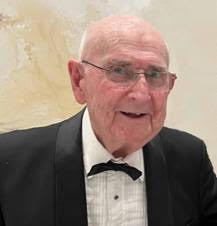
Stanley H. Galezowski, the Avro Arrow, and his connection to Windsor, Ontario
From an early age, Stanley Galezowski was fascinated by airplanes and flight, a passion that inspired him to pursue a career in aeronautical engineering, earning a BASC in 1956 and a MASc in 1957 from the University of Toronto, both in Aeronautical Engineering.
His professional journey began during an exciting era in Canadian aviation
Work at Avro Arrow
While at Avro, Galezowski focused heavily on analog simulation, flight control dynamics, and stability augmentation. Flying an advanced fly-by-wire delta-wing aircraft at Mach 2 required automated assistance far beyond standard autopilots of the era.
While working at Avro Canada, he, along with the entire workforce, learned over the PA system that their employment had been terminated. Within days following the ‘Black Friday’ announcement however, his expertise was recognized, and he was called upon to assist NASA in the historic quest to orbit the moon.
Work at NASA
Within weeks of the cancellation, a select group of elite Avro engineers (including Galezowski) migrated south to join NASA’s Space Task Group. These pioneers became foundational leaders of the Mercury, Gemini, and Apollo programs, playing central engineering roles in eventually putting humans on the moon.
At NASA, he worked in the Langley analog simulation labs alongside colleague David D. Ewart, using his automated flight control expertise to construct the critical math models and simulation profiles used for the manually guided atmospheric re-entry of spacecraft.
- The Mercury Phase (Proving Feasibility): During Project Mercury, the Flight Controls Section dealt with a relatively rudimentary ballistic environment. The Mercury capsule was designed with simple automated orientation routines, primarily using the launch vehicle’s guidance system to achieve a predictable, non-lifting low Earth orbit. As astronauts demanded a manual override capability, Galezowski’s team began evaluating how human inputs would interact with automated reaction control thrusters.
- The Bridge to Apollo (Langley Analog Simulation): While the Space Task Group prepared to relocate to Houston to form the Manned Spacecraft Center, key technical engineers stayed behind at NASA’s Langley Research Center. Operating out of Carley’s analog lab, Galezowski took on the critical assignment of constructing math models for an Apollo-scale mission. He built an analog flight control simulation profiling a manually guided atmospheric entry of the Apollo spacecraft around a rotating Earth. Because a lunar return spacecraft hit the atmosphere at a blistering 36,000 feet per second, the entry corridor was dangerously narrow. Galezowski partnered directly with David D. Ewart, who personally flew roughly 140 simulated manual entries using Galezowski’s mathematical loops to prove that human-guided lunar re-entry was survivable and repeatable.
- The Apollo Phase (Managing Complex Physics): When the section fully transitioned to the Apollo design architecture, the baseline logic flipped from Mercury’s simple zero-lift ballistic drops to guided lifting entries. To prevent the Apollo Command Module from burning up or skipping off the atmosphere, the flight control systems had to actively bank the spacecraft to generate aerodynamic lift. The predictive models designed by Galezowski’s section were ultimately translated into the logic architectures used by the onboard digital Apollo Guidance Computer (AGC).
Return to Canada
In 1962, Stan returned to Canada with his beloved wife, Stephanie Emily Galezowski (nee Slama), whom he had married on September 26, 1959, and their two young children, Steven and Louise. Embracing the dawn of a new technological age, he became one of the pioneers of Canada’s emerging computer industry with IBM.
His Connection to Windsor, Ontario.
Never one to shy away from a new challenge, Stan later left the corporate world and, together with Emily, discovered his true calling as a Canadian Tire dealer. Their successful retail career took them first to Arnprior and later to Windsor, where he operated the Canadian Tire Store at Dougall and Cabana (now GoodLife Fitness).
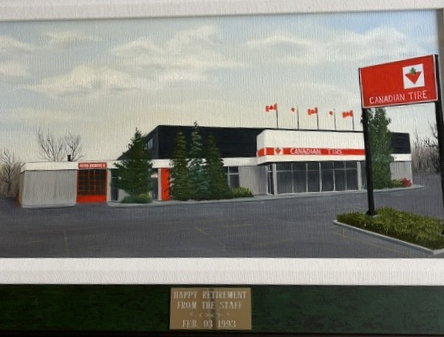
(now GoodLife Fitness)
Related Story: Avro and the NASA Canadians